What to Hand Off First in Your Business (And What to Keep)

Photo by Karan Wang
I was sitting down to design an Instagram post, the kind I'd learned to stay consistent with from social media strategist Xanthe Appleyard. I'd already spent a couple of days getting the copy just right in my phone's notes app, and now it was time to turn it into an actual carousel: sourcing the right photos, getting the fonts aligned just right, and making sure it felt scroll-stopping. All in all, this was a four-hour affair.
And my brain did some quick, involuntary math: two posts a week at four hours each is 32 hours a month. That's a legit part-time job! Just for Instagram graphics.
Here's the thing I’ve come to learn about building a business: sneaking in extra hours here and there feels totally normal when you're growing. Research, marketing, admin, design, launching, strategy (it’s a lot!), and it all adds up fast. Most of the time, you don't even notice how much time you're spending on things until you actually, typically unwillingly, decide to do the math.
I started Willow and Jax thinking I'd build an agency in the early days, and somewhere along the way, I convinced myself that no one could do things quite like I could, so I settled happily into being the solopreneur running the whole show. But the truth is, the most successful businesses aren't doing everything themselves. At the very least, there's a VA behind the scenes keeping things moving while the founder stays focused on the work only they can do.
If you've ever said, "I don't know what to hand off," I'd guess what you're actually nervous about isn't what the tasks actually are. It's giving someone else your responsibility and training them to do it exactly how you'd do it. Or worse, handing off something so layered and complex that you end up having to redo it anyway. That fear is valid. But it usually means you haven't gotten specific enough yet about what you'd be handing off, not that you shouldn't hand anything off at all.
Introducing: The Zone of Genius Framework
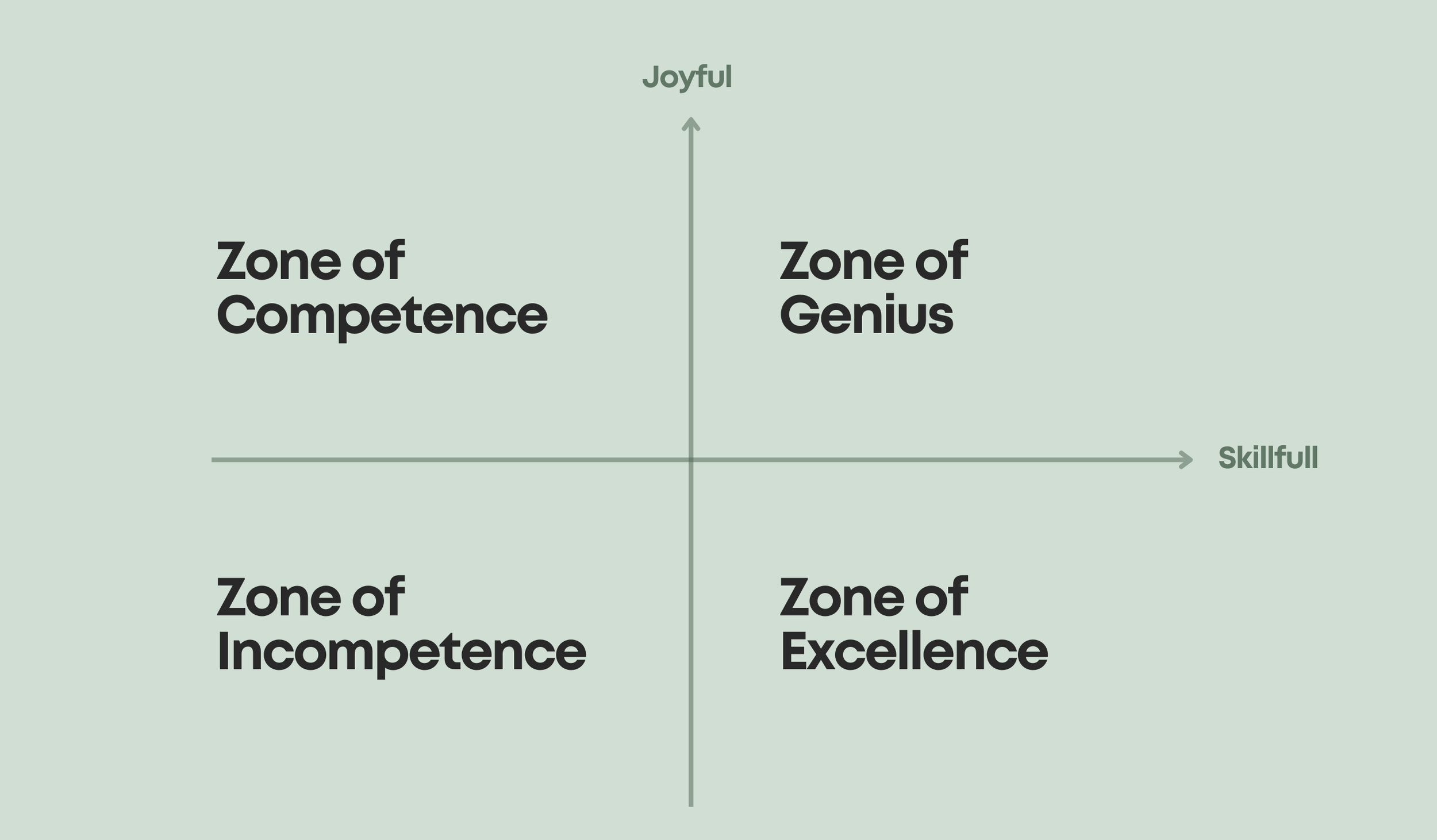
Image via sydneychamberlain.com
This framework comes from Gay Hendricks' book The Big Leap, and it's the single best tool I've found for figuring out what to hand off and why.
Here's how it breaks down.
Zone of Genius: This is the work you love and are great at. This is where you're at your best and feel the most energized, and it’s often tied to your IP. This, we protect this at all costs.
Zone of Excellence: The work you're good at, but doesn't exactly energize you. You could do it all day, sure, but it doesn't really light you up. This one is worth taking a closer look at.
Zone of Competence: Work you can do, and often have to, but someone else can do just as well, or maybe better. This is prime hand-off territory.
Zone of Incompetence: This is the work you struggle with or find yourself actively avoiding. This is what I call “the pits” of business. It has to get done, but man, is it the pits. This, you hand off as soon as you can.
My Zone of Genius Breakdown
Let me show you what this looks like in practice, using my own business.
My Zone of Genius: Strategic thinking, problem solving, and project planning. This is what I bring to the table, and I can do with one hand tied behind my back. It excites me, and it creates massive value for my clients.
My Zone of Excellence: Workflow and process mapping, and documenting procedures. Even though this work isn't always "fun," it's work I do really well and have a unique approach to. I don’t often enjoy it in the moment, but I’m always proud of the finished product.
My Zone of Competence: System setups, branding messaging, and copywriting. I can absolutely do these things, but someone else could do them just as well, if not better, and honestly, they'd probably enjoy it more than I do.
My Zone of Incompetence: Graphic design, marketing, and bookkeeping. These tasks either drain me completely or take me way longer than they should. I’m too much of a perfectionist, and not exactly skilled at math, which makes these not my wheelhouse.
When I mapped this out, it became clear that Instagram graphics really had to go. They lived squarely in my Zone of Incompetence, and they were eating hours out of my week that I could've spent on the work only I can do.
The Questions to Ask Yourself
Mapping your own zones starts with asking a few questions to help you identify what exactly in your business falls into each zone.
Here's what I typically ask my clients.
Zone of Genius
What do you know, without a doubt, that you do better than most people?
What’s the work that gets you out of bed in the morning?
What could you basically do in your sleep?
Zone of Excellence
What are you good at, but typically dread getting started on?
What feels like it's draining your energy or becoming a total time suck?
What makes you feel the most satisfied, proud, or happy once it's done?
Zone of Competence
What's something you do that pretty much anyone could do just as well?
What takes you way too long, even though the end result is perfect?
What feels "beneath you" at this particular stage of your business?
Zone of Incompetence
What feels heavy and requires total concentration just to get through?
What feels uninspiring or unfulfilling, no matter how you approach it?
What's your least favorite part of your work, the thing that makes you consider quitting on a hard day?
And each person, business, and process is so unique. For example, one of my clients delegated her discovery calls to an office manager because she realized she genuinely didn't enjoy them, and wasn’t very good at them either.
For my business, discovery calls feel like an essential, personal touchpoint that I, as the founder of the business, have to be involved in. But for her, they were draining, and they weren’t helping the business. Once she handed them to someone who actually loved that kind of conversation, her whole sales process improved.
What feels difficult to you might be someone else's superpower, and the only way to know is to ask yourself the questions above, not borrow someone else's strategy.
How to Put Your Zone of Genius into Practice
Knowing a task lives in your Zone of Incompetence is the first step. The second, the part that most people skip, is getting specific enough that you could hand someone a real job description for their role, instead of a vague idea.
I would start by tracking your time on the tasks you mean to delegate for a week or two. It sets real expectations for how long it should take once someone else owns it. And if the task is tech-forward, anything that involves a platform or a tool, record a Loom video of yourself doing it in the process. It takes almost no extra time in the moment and builds you a training library you'll be grateful for the day you're ready to hand it off.
I also recommend building out a roles and responsibilities outline, not just for whoever you eventually hire, but for yourself, too. It removes any ambiguity about who owns what, including the things you're still holding onto.
Once you know what you're handing off, here's how to get specific about scope:
Check your service agreements for any policies tied to that task, so everyone stays consistent with what you've already promised clients.
Map the process step by step, start to finish. Publishing a blog post, for example, might break into five parts: setting up the backend SEO, sourcing and optimizing images, publishing it live, running it through your SEO tool, and creating promotional graphics.
Write a simple SOP for each part: how you actually source images, which website you use, what the requirements are, and so on.
Add a timeline (how long this should take, when it happens) whenever possible, and assign each part to a specific person. Maybe your VA owns parts one through four, and your graphic designer owns part five, for example.
Lastly, link out to every resource needed to complete it: Canva templates, Loom tutorials, training docs, whatever already exists that can make the process of completing the task easier.
From there, a project management tool like Asana or Notion is your natural next step. It's what keeps everyone accountable, transparent, and consistent without you having to check in on every single task.
The most common way this goes wrong happens at the extremes. Either you expect the person you hire to read your mind and run your business without you sharing a thing, or you over-train on the smallest details, leaving zero room for autonomy, and then feel resentful when they don't absorb everything instantly. The fix is the same either way: document the resource, then give them space to use it, with your support close by when they need it. It’s the secret to scaling that feels simple.
Grab the CEO’s Delegation Playbook

If this got your wheels turning, the CEO's Delegation Playbook is the next best place to put it into action. It walks you through documenting your processes, building clear SOPs, and handing off tasks with actual confidence, whether you're making your very first hire or building out a full team.